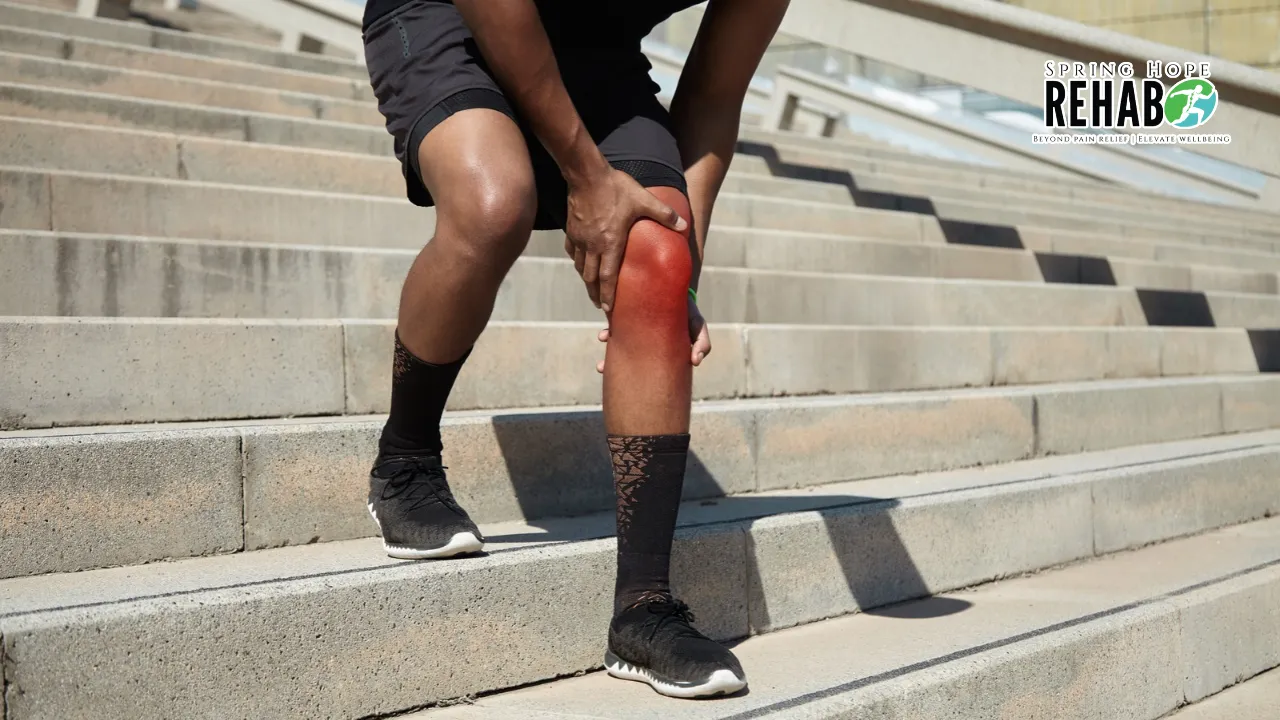
It is one of the most oddly specific complaints in the whole of knee pain: going up the stairs is fine, but coming down hurts. Many people notice it for the first time on a staircase, a sharp or aching discomfort at the front of the knee with each step down, and quietly start taking the stairs one at a time, or reaching for the handrail. It is common, it is frustrating, and it has a clear mechanical explanation.
Understanding why descending stairs is harder on the knee than climbing them makes the problem far less mysterious, and points towards what actually helps. Here is a look at the mechanics behind this familiar complaint and what tends to strengthen and settle it.
Why Down Is Harder Than Up
The key lies in what the muscles around the knee are doing on the way down. Climbing stairs is mostly a lifting action: the thigh muscles shorten to push the body up. Descending is the opposite and, for the knee, more demanding. On the way down, the thigh muscles have to work while lengthening, acting as a brake to control the body’s descent against gravity, step after step.
This braking action loads the joint between the kneecap and the thigh bone, the patellofemoral joint, with the knee bent and bearing weight. An expert-reviewed physiotherapy knowledge base notes that activities which load the kneecap joint while the knee is bent, stairs very much included, are classic aggravators of front-of-knee pain. Descending adds the extra demand of controlled braking, which is precisely why coming down a staircase so often hurts more than going up.
What This Pain Usually Reflects
Pain at the front of the knee on stairs is frequently part of the picture known as patellofemoral pain, or runner’s knee, which an expert-reviewed physiotherapy knowledge base describes as pain felt at the front of the kneecap, around it, or behind it. Contributing factors commonly include weakness or poor coordination in the thigh and hip muscles, the way the kneecap tracks, and overall load on the joint.
In older adults, front-of-knee discomfort on stairs can also relate to osteoarthritis. Singapore public hospital guidance notes that in knee osteoarthritis a grating or clicking sensation can occur with movement, and that pain and stiffness typically follow activity. The common thread across these is the same: the knee is being loaded in a demanding way, and the muscles that should be controlling and protecting it may not be coping as well as they could.
What Tends to Strengthen It
Because the muscles that brake the body on the way down are central to this problem, building their strength and control is usually at the heart of improving it. An expert-reviewed physiotherapy knowledge base describes exercise therapy, particularly strengthening of the hip and thigh muscles, as effective for relieving this kind of front-of-knee pain in both the short and long term, and notes that the strengthening should be continued over time rather than treated as a quick fix.
Importantly, this does not mean avoiding stairs or the knee forever. The general principle in managing front-of-knee pain is to ease off the most aggravating activities for a while rather than stopping all activity, while building the strength and control that let the knee handle load again. The particular muscles to target, and how to progress, are best worked out with professional guidance, because the right approach depends on what is driving the problem in each individual. For that reason, this is a situation where an assessment is far more useful than a generic set of exercises.
When to See a Professional
Occasional twinges on the stairs may settle with a little care and reduced load. It is worth seeking an assessment when the pain is persistent, happens with most trips down the stairs, is limiting daily life, or is not improving. Swelling, locking, giving way, or a knee that is painful at rest are all reasons to have it looked at sooner. A registered physiotherapist can assess the knee, identify the contributing factors, and guide targeted strengthening, and for those who would prefer to be seen at home, a home-based Physiotherapy Clinic can bring that assessment directly to the patient, which can be especially helpful when stairs themselves are the problem. Persistent or severe knee pain should also be reviewed by a doctor. In Singapore, physiotherapists must be registered with the national allied health regulator in order to practise, so it is worth checking that a practitioner is properly registered before booking.
Key Takeaways
- Descending stairs is harder on the knee than climbing because the thigh muscles must brake the body while lengthening, under load and with the knee bent.
- This loads the kneecap joint in exactly the way that provokes front-of-knee pain, which is why down often hurts more than up.
- The pain commonly reflects patellofemoral pain, and in older adults can relate to knee osteoarthritis.
- Strengthening the hip and thigh muscles is an effective, well-evidenced way to improve it, and should be continued over time.
- Persistent stair pain, or any swelling, locking or giving way, is worth having assessed.
Conclusion
Knee pain that bites going down the stairs but not up is not a quirk, it is mechanics: descending asks the thigh muscles to brake the body under load, and that is demanding for the kneecap joint. The encouraging part is that this also points to the solution. Rather than avoiding stairs indefinitely, the more effective path is usually to build the strength and control that let the knee manage that braking work again. When the pain persists or starts limiting everyday life, a qualified physiotherapist or doctor can assess what is behind it and guide the way back to easy, confident steps.
The information provided in this post is for general educational purposes only and does not constitute medical advice. Please consult a qualified healthcare professional or a registered physiotherapist for an assessment of your individual condition.